Business
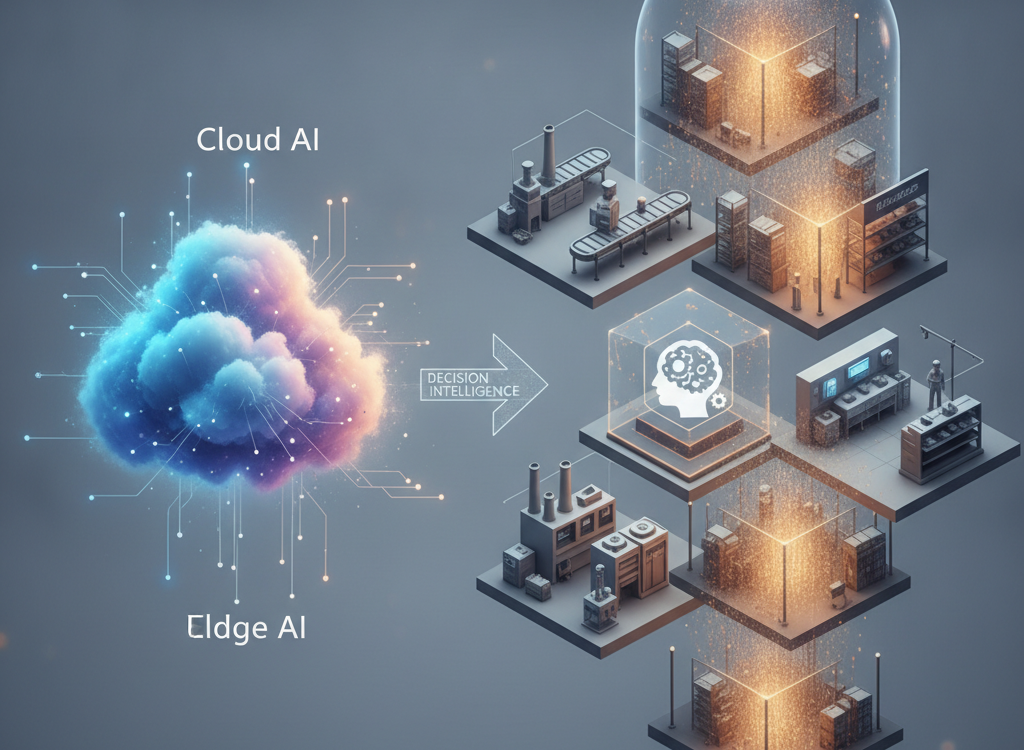
Business leaders have spent the last two years hearing that artificial intelligence will transform everything. That part is true. What is less understood is where that intelligence will actually live. For many organizations, the next major shift will not be a better chatbot in the public cloud. It will be AI moving closer to the work itself, inside the business, where decisions are made, data is created, and operations depend on speed and control.
That shift has a name: edge computing. And for executives thinking about AI strategy, business automation, and digital transformation, it is becoming hard to ignore.
Edge Computing Explained In Business Terms
Edge computing simply means processing data near the place where it is created, instead of sending everything back to a central cloud data center. In plain terms, it is the difference between asking an outside system to think for you versus having intelligence available inside your own environment.
That distinction matters more than it first appears. A factory line, a warehouse, a hospital unit, a construction site, a retail store, or a field service truck all create data continuously. Not all of that data should leave the organization. Not all decisions can wait for a round trip to the cloud. And not every workflow is best served by a public service that treats your business like one account among millions.
Cloud AI still has an important place. It is useful for scale, training, collaboration, and broad-access tools. But cloud AI is not the same as operational AI. Cloud AI often depends on remote processing, third-party infrastructure, and internet connectivity. Edge AI, by contrast, runs closer to the user, the machine, the facility, or the workflow. That difference can improve speed, resilience, privacy, and control.
For business owners, the issue is not technical elegance. It is practical performance. If a system helps a manager make a better call in seconds instead of minutes, keeps confidential information in-house, or continues to work when connectivity is limited, that is a business advantage.
Why AI Is Moving Closer To The Work
The first wave of AI adoption focused on conversation. Ask a question, get an answer, draft a document, summarize a meeting. Useful? Yes. Sufficient? No.
Most business value does not come from isolated prompts. It comes from systems that understand context, follow rules, interact with workflow, and support decisions inside the operating rhythm of the company. That is why AI is moving away from being treated as another chatbot and toward being treated as infrastructure.
Organizations increasingly want AI that operates within their own environment for several reasons:
- Speed: Local processing reduces latency. In operations, that can matter immediately.
- Resilience: Systems that do not depend entirely on external cloud access are less vulnerable to outages and connectivity issues.
- Privacy: Sensitive financial, operational, client, patient, or employee data can stay inside the organization.
- Control: Businesses can decide how models behave, what data they use, and where outputs are stored.
- Compliance: Many organizations need to align with internal security policies, contractual obligations, or regulatory requirements.
This is especially relevant in industries where the cost of delay is high. In manufacturing, edge AI can help identify defects, monitor equipment, and support quality control without sending every image or sensor reading to a public cloud. In healthcare, local AI can assist with documentation, workflow routing, and policy-driven support while keeping sensitive information under tighter organizational control. In public safety, field teams need systems that work in uncertain connectivity conditions. In logistics, a decision made at the dock, on the route, or inside the warehouse can save hours.
The same logic applies in professional services and accounting. Firms are not simply looking for faster writing tools. They need secure AI workflows that can help organize documents, support analysis, review exceptions, and preserve client confidentiality. Construction leaders need jobsite intelligence. Retailers need in-store insight. Advisors need systems that help them move from information to action.
From AI Tools To AI Infrastructure
Business leaders should stop thinking of AI as a single product and start thinking about layers.
At the top are the visible tools: chat interfaces, copilots, assistants, and agent-style workflows. Beneath those are the business systems: finance, CRM, ERP, knowledge management, operations, and reporting. Deeper still is the infrastructure layer: private AI, local AI appliances, edge AI deployments, workflow automation, and decision intelligence platforms.
That infrastructure layer is where the long-term opportunity sits.
A company that simply asks public AI systems questions will always be limited by what those systems know, how they are governed, and what they can safely access. A company that builds an intelligence layer around its own business can create something more valuable: systems that understand its processes, its terminology, its priorities, and its data.
That is the future of business AI. Not generic answers, but organizational intelligence.
Imagine purpose-built systems supporting finance, operations, marketing, leadership, sales, customer service, compliance, manufacturing, and public safety. In finance, AI can help monitor exceptions, surface variance, and support forecasting inside secure workflows. In operations, it can watch for bottlenecks and route tasks. In marketing, it can align content and campaigns with approved messaging and customer segments. In sales, it can prepare account summaries and next-best-action prompts using internal knowledge.
In customer service, local AI can answer routine questions while escalating exceptions. In compliance, it can help maintain consistency and documentation. In manufacturing, it can support quality checks, maintenance, and production visibility. In public safety, it can help teams process information quickly without relying entirely on external services.
These systems will not all live in the cloud. Many will run locally or in private environments because that is where trust, control, and operational reliability are strongest.
Why This Matters To Business Decision Partners
This is where Business Decision Partners fits naturally into the conversation.
BDP has always focused on helping business owners make better decisions through systems, workflows, financial visibility, operational clarity, and practical execution. That philosophy aligns closely with where AI is heading. The next phase is not about adding another layer of novelty. It is about building better decision support into the structure of the business.
That means private AI. It means business intelligence that is more actionable. It means advisor intelligence that supports trusted judgment. It means workflow automation that removes friction without removing oversight. It means AI agents that work inside defined processes. It means secure organizational knowledge that can be accessed when needed, not scattered across tools. It means Decision Intelligence that helps leaders see, decide, and act with more confidence.
BDP is not claiming to have invented edge computing, and it is not trying to position itself as the market leader in every AI category. What it is doing is recognizing where business technology is going and preparing clients for that future. That distinction matters. The organizations that will benefit most are the ones that start designing for the intelligence layer now, rather than waiting until their competitors already have it.
For small business owners in particular, this is not a distant enterprise trend. It is an opportunity to build an AI strategy that fits the realities of the business: limited time, sensitive data, lean teams, and the need to make better decisions with fewer moving parts.
The question is no longer whether AI will become part of daily operations. It already has. The real question is whether that intelligence will sit outside the business as a rented utility, or inside the business as a controlled capability.
The companies that win the next phase of digital transformation will not be the ones with the most chatbots. They will be the ones that build systems of intelligence around their own people, their own workflows, and their own data.
That is the direction BDP is watching, advising toward, and building for.
Business leaders who want to prepare should start now: map the decisions that matter most, identify where latency, privacy, and control are important, and look at which workflows would benefit from local AI or private AI rather than another external tool. The future is not about asking an AI a question. It is about owning the intelligence layer of the business.
For organizations that want a trusted guide through that transition, Ask BDP is positioned to help them think beyond tools and toward durable AI infrastructure. The companies that begin preparing today will be the ones best positioned to use AI as a core business capability tomorrow.