Policy & Regulation
Charlottesville recently launched a program to help small businesses lower their energy costs. On the surface, it sounds like a win.
Businesses can receive free energy audits, technical guidance, and grants to help pay for improvements like LED lighting, HVAC upgrades, smart thermostats, insulation, and weatherization. These upgrades can reduce monthly utility bills and improve building efficiency. For owners considering larger changes, building-efficiency improvements also need to fit the practical needs of the space.
Those are worthwhile goals.
But they also expose a larger question that communities across America should be asking.
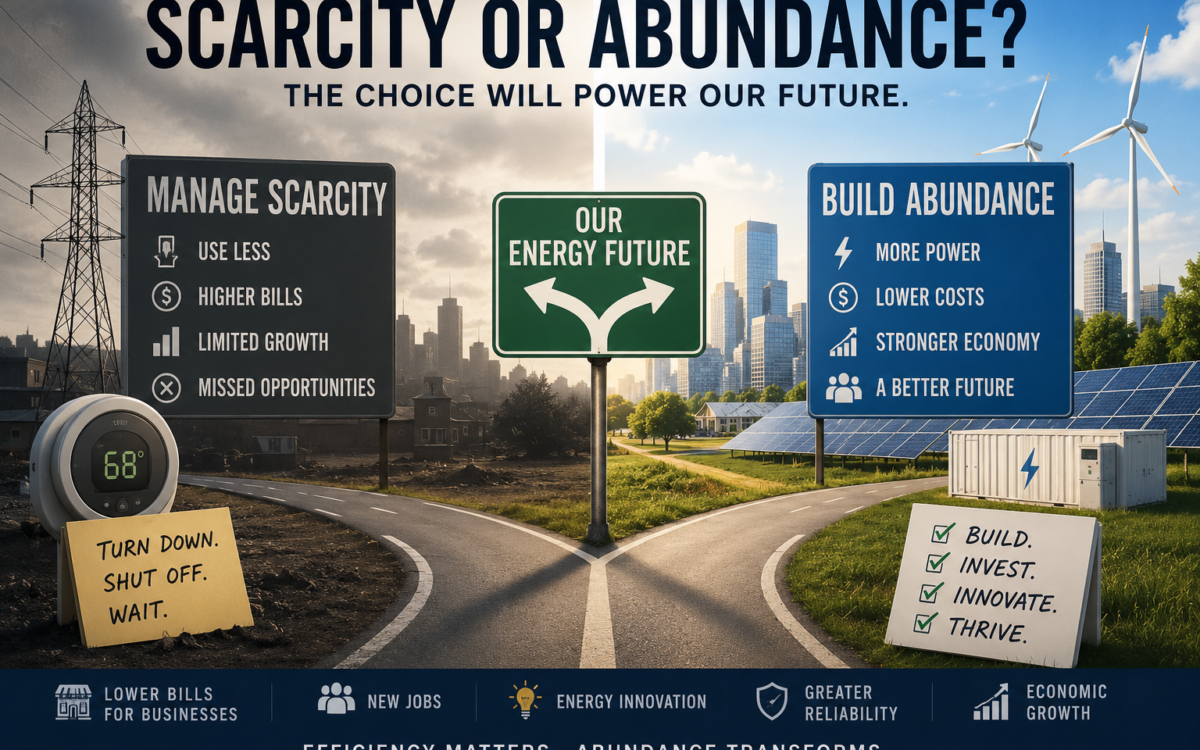
Why does so much of our energy policy focus on using less instead of producing more?
The Difference Between Efficiency and Abundance
Energy efficiency matters.
No one argues that businesses should waste electricity. Better lighting, better insulation, and modern equipment save money. They reduce operating costs and often pay for themselves over time.
The problem begins when efficiency becomes the entire strategy.
Many government programs tell citizens to:
- Turn the thermostat down.
- Shift electricity use to different hours.
- Buy more efficient appliances.
- Consume less.
Those ideas treat energy like a scarce resource that must be rationed.
What they rarely ask is:
How do we build enough energy so scarcity stops being the problem?
Imagine If We Thought Bigger
America became an economic powerhouse because previous generations built infrastructure before demand arrived.
They built interstate highways.
They built airports.
They built railroads.
They built dams.
They built power plants.
They didn’t simply tell people to drive less.
Today’s economy depends on electricity more than ever.
Artificial intelligence.
Electric vehicles.
Advanced manufacturing.
Robotics.
Medical research.
Every one of those industries requires enormous amounts of reliable electricity.
Trying to conserve our way into the future will never create enough capacity for what’s coming.
The Missing Conversation
When communities debate data centers or growing power demand, the discussion usually centers on higher electric bills, environmental concerns, or who pays for new infrastructure.
Those concerns deserve attention.
But another question almost never enters the conversation.
How can these investments leave the community stronger than it was before?
Instead of asking companies to simply reduce consumption, communities could ask:
- Can new infrastructure lower residential electric rates over time?
- Can private investment help modernize the local grid?
- Can battery storage improve reliability during outages?
- Can community solar reduce long-term operating costs?
- Can waste heat from data centers support nearby industries?
- Can excess generation attract new employers?
- Can new energy technologies create skilled local jobs?
Those conversations move beyond managing demand.
They focus on expanding opportunity.
Efficiency Is Not the Enemy
This isn’t an argument against conservation.
Businesses should absolutely eliminate waste.
Families should benefit from lower utility bills.
Efficient buildings make sense.
But efficiency should support growth, not replace it.
The strongest energy strategy combines both.
Build more generation.
Modernize the grid.
Invest in storage.
Improve transmission.
Increase reliability.
Then help consumers use that abundant energy wisely.
From Scarcity to Opportunity
Communities often ask citizens to sacrifice while asking innovative companies to innovate.
Perhaps it’s time to reverse that equation.
Ask innovators to solve bigger problems.
If billion-dollar technology companies require enormous amounts of electricity, challenge them to become part of the solution.
Not through slogans.
Through engineering.
Through investment.
Through infrastructure.
Imagine a future where new energy projects don’t simply meet demand.
They lower rates.
Improve reliability.
Strengthen the electric grid.
Create local jobs.
Support schools through a stronger tax base.
Attract manufacturers.
Power AI companies.
Give entrepreneurs confidence to build.
That is an abundance mindset.
Charlottesville’s new program may help businesses reduce their monthly electric bills. That’s a positive step.
But America still needs to answer a much larger question.
Are we building a future that teaches people to consume less, or one that gives them access to more?
The communities that answer that question with bold infrastructure, practical innovation, and long-term thinking may become the economic leaders of the next generation.