Regional Opportunity
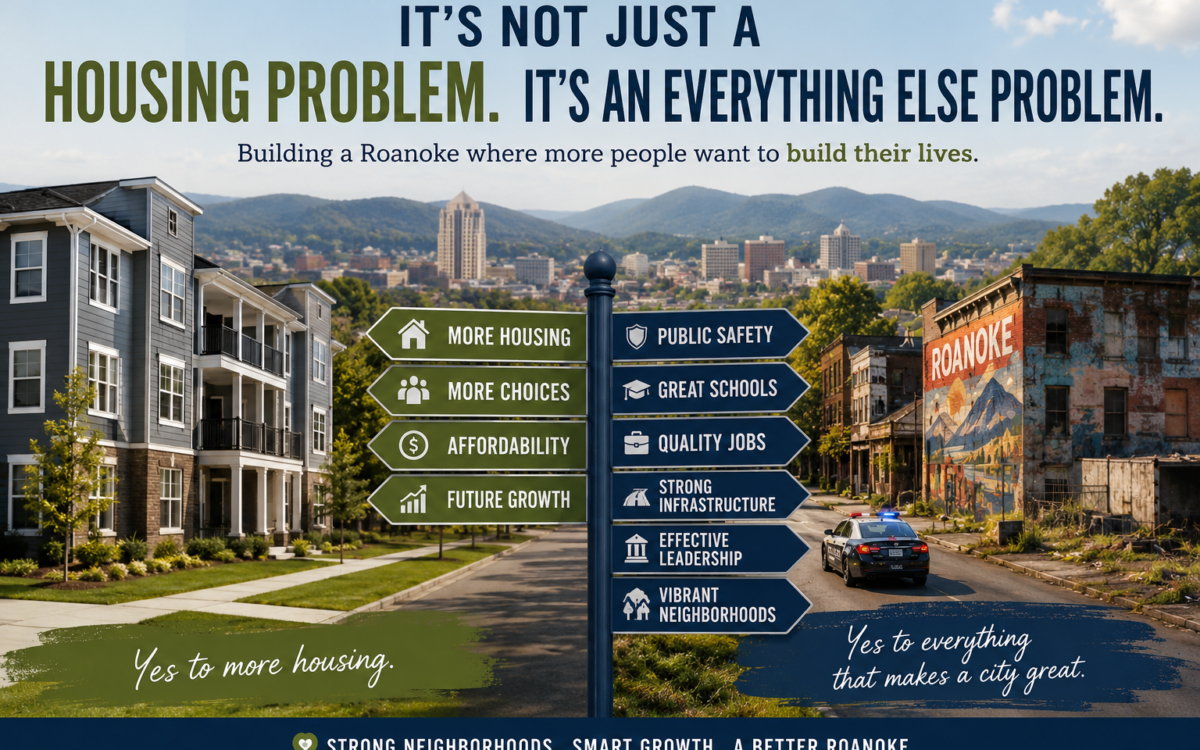
If you’ve followed Roanoke’s recent zoning debate, you’ve probably heard one phrase repeated over and over:
“We have a housing shortage.”
That belief drove the city’s decision to rewrite its zoning code, making it easier to build duplexes, triplexes, fourplexes, and other higher-density housing in many neighborhoods.
Supporters argue more housing will increase supply, improve affordability, and prepare Roanoke for future growth.
Critics worry about neighborhood character, traffic, parking, infrastructure, and the loss of public input.
Those concerns matter.
But I think we’re asking a bigger question.
What if housing isn’t the only problem?
Across the country, a growing conversation has emerged among economists, city planners, developers, and community leaders.
Some argue that many cities don’t simply have a housing problem.
They have an “everything else” problem.
Think about it.
If a neighborhood struggles with crime, aging infrastructure, weak schools, high taxes, vacant commercial buildings, slow permitting, or limited economic opportunity, will building more housing alone solve those issues?
Probably not.
Housing is one piece of a much larger puzzle. For owners weighing how an existing home can meet changing needs, this Roanoke construction-and-remodeling overview addresses the project-planning side of that separate, practical decision.
Why people choose where they live
People don’t move somewhere because a house exists.
They move because they believe they can build a better life there.
Families ask questions like:
- Is it safe?
- Are the schools good?
- Can I find a good-paying job?
- Is the city well managed?
- Can I start a business?
- Are parks and recreation nearby?
- Will my investment grow over time?
Those questions often matter just as much as the number of available homes.
The Roanoke opportunity
Roanoke has tremendous assets.
We have beautiful outdoor recreation, a growing healthcare sector, higher education, an active downtown, and a cost of living that remains attractive compared to many larger metropolitan areas.
Those strengths should become the foundation of our strategy.
The question shouldn’t simply be:
“How do we build more housing?”
The better question is:
“How do we build a city people are excited to call home?”
Think bigger than zoning
Imagine if Roanoke became known for:
- The safest neighborhoods in Virginia.
- Schools that attract young families.
- Entrepreneur-friendly policies.
- Faster permitting for responsible development.
- Modern infrastructure.
- Reliable utilities.
- Vibrant parks and public spaces.
- Workforce development tied directly to local employers.
Now ask yourself this:
Would developers still want to build here?
Absolutely.
In fact, demand for housing would likely increase because more people would want to live here.
Housing is part of the solution
None of this means housing supply doesn’t matter.
It does.
Growing cities need places for people to live.
But zoning reform alone cannot solve challenges that involve public safety, education, infrastructure, economic development, and government performance.
Treating housing as the only issue risks overlooking the conditions that make a city successful in the first place.
A vision worth pursuing
Roanoke has an opportunity to lead.
Instead of arguing over housing versus neighborhoods, we can pursue both.
Build housing where it makes sense.
Protect neighborhoods that define our community.
Invest in public safety.
Strengthen schools.
Support entrepreneurs.
Improve infrastructure.
Create jobs that encourage young people to stay after graduation.
When people believe they can build a future in a city, housing becomes part of a larger success story.
That’s the conversation I hope we continue.
Because the goal shouldn’t simply be to build more homes.
The goal should be to build a city where more people want to build their lives.