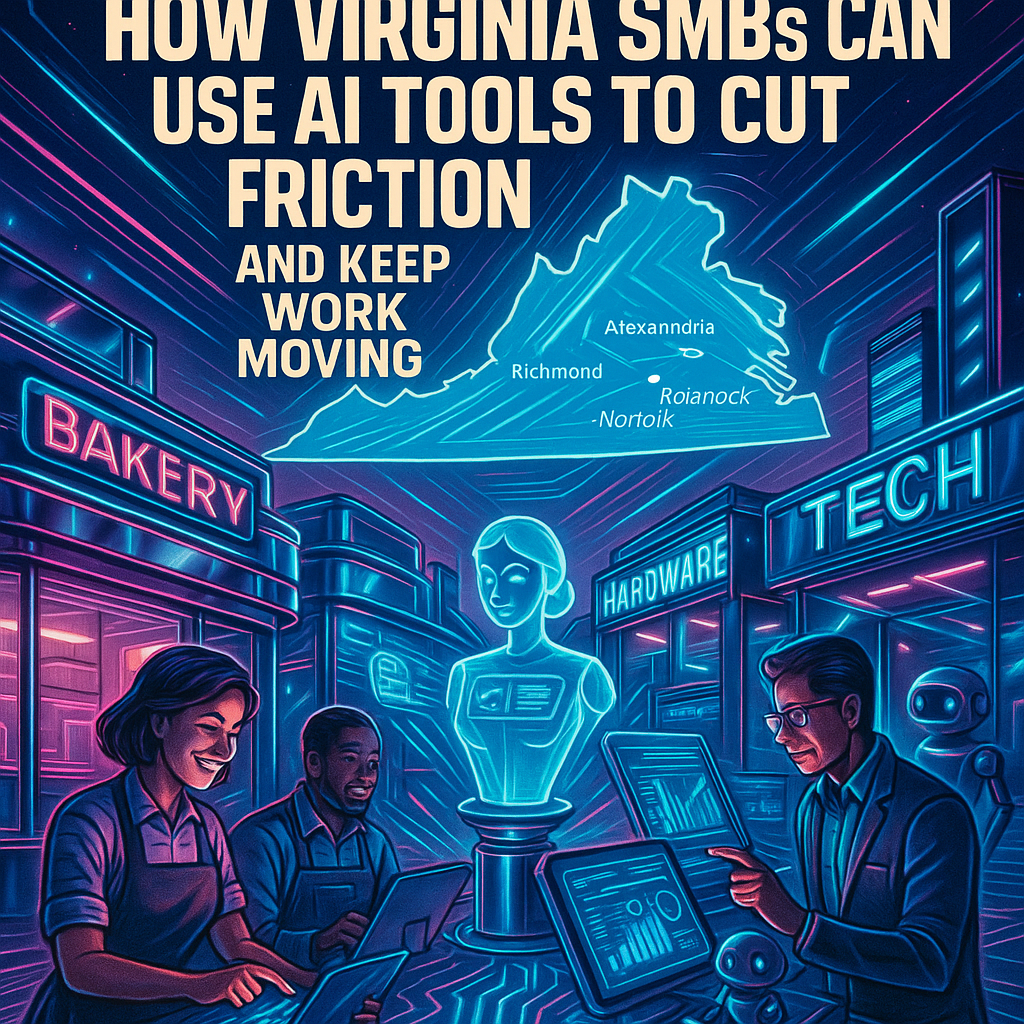
How Virginia SMBs Can Use AI Tools to Cut Friction and Keep Work Moving
A lot of small business owners in Virginia are not asking whether AI matters anymore. They are asking where it fits without creating more work, more cost, or more confusion.
That question came into focus for many operators when they saw larger organizations using artificial intelligence to handle routine tasks, support customer conversations, and make faster decisions. The lesson for smaller firms was not that they need giant budgets. It was that they need better workflows.
Why AI tools for small business work best when they solve one real problem
The fastest way to waste time with AI is to treat it like a strategy instead of a tool. A better approach starts with one bottleneck that slows the business every week.
Maybe the problem is answering the same customer questions over and over. Maybe it is sorting through invoices, notes, estimates, or emails. Maybe it is turning scattered information into something a manager can actually use.
The best early wins usually come from narrow tasks. If a process already follows a pattern, AI can often help reduce the time spent on it. If a process depends on judgment, relationships, or local context, AI should support the work, not replace it.
That distinction matters because small businesses rarely fail from lack of effort. They fail when their best people spend too much time on low-value work.
Start with operations, not novelty
A practical AI rollout begins in the back office. Scheduling, document summaries, call notes, internal search, and customer message drafts are common starting points because they do not require a full rebuild of the business.
A service company with five employees may not need anything advanced. It may simply need help turning a handwritten job note into a cleaner estimate. A retail shop may not need a data science project. It may need a better way to summarize customer feedback from reviews and emails.
The point is to use AI where repetition creates drag. When a task happens often enough, even a small time saving can free up real capacity.
This is also where leadership shows up in a practical way. The job is not to chase every new tool. The job is to decide which workflow deserves attention, set a clear standard, and keep the team focused on the work that actually moves the business.
The real payoff comes from faster decisions
Many owners think of AI as an automation layer. In practice, its bigger value often comes from helping people make decisions sooner.
A manager who waits until Friday to review customer issues has already lost time. A manager who can see a concise daily summary can act while the issue still matters. A buyer who reviews inventory trends once a week may miss a pattern. A buyer who gets a simple warning before stock runs thin can plan with less stress.
That matters in Virginia because many SMBs operate in mixed markets. They serve local customers, but they also depend on outside vendors, energy costs, shipping timelines, and labor availability. A small improvement in visibility can make the whole business feel steadier.
The same principle applies to energy technology. Businesses that track electricity use more closely can spot waste faster, plan around peak demand where possible, and make smarter upgrades over time. In a state where costs and reliability shape operating decisions, that kind of visibility is a competitive advantage.
Energy tech is becoming an everyday business issue
AI gets most of the attention, but energy technology is quietly changing how small businesses think about cost control. Better monitoring, smarter equipment controls, and tighter building management can reduce wasted spend without changing the core business.
For a bakery, warehouse, clinic, or light manufacturing shop, energy use is no longer just a utility bill. It is part of operations planning. When equipment runs inefficiently, margins shrink. When heating, cooling, or refrigeration systems are managed poorly, the business pays for it every month.
Large technology projects also have a ripple effect. As more computing and data infrastructure demand power, more attention goes to grid reliability, efficiency, and on-site resilience. Small businesses do not build those systems, but they still feel the outcome through prices, outages, and equipment decisions.
That is why the smartest owners think about technology and energy together. A new software tool is only helpful if the business can support it. A new piece of equipment is only worthwhile if it reduces waste enough to matter.
Build trust before you build dependence
AI tools work best when people understand their limits. That means businesses need a few simple guardrails.
First, keep humans in the loop for anything customer-facing, financial, or legally sensitive. AI can draft, summarize, and sort. It should not make final calls without review.
Second, use clean inputs. If the business stores poor data, the output will reflect that. A messy customer list, inconsistent job notes, or incomplete inventory records can make even a useful tool feel unreliable.
Third, train the team on what the tool is for. People do better with clear rules than with vague encouragement. If a team knows which tasks to try first, where to check the output, and when to override it, adoption usually goes more smoothly.
Finally, measure time saved, not just activity added. If a tool creates more steps than it removes, it is not helping.
The businesses that gain the most will keep the scope small
The strongest pattern among early adopters is simple. They do not start with a transformation story. They start with one job that takes too long and fix it.
That can mean a better way to handle customer messages. It can mean faster scheduling. It can mean fewer missed follow-ups. It can mean lower energy waste. None of that sounds dramatic, but that is exactly the point.
Small and medium-sized businesses do not need to become tech companies to benefit from emerging technology. They need to use it with discipline, patience, and a clear sense of what problem it solves.
In the end, the real advantage is not having AI. It is knowing where technology removes friction and where people still need to lead.
Leave a Reply